Concepts
The optic disc and the cup-to-disc ratio
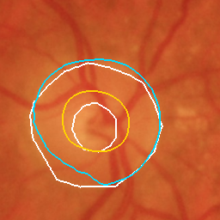
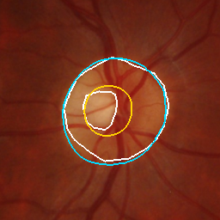
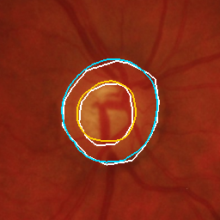
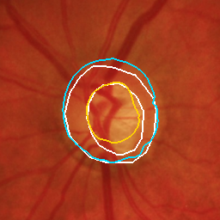
The optic disc is where the ganglion-cell axons leave the eye. They form the neuroretinal rim, the orange-pink ring; the pale hollow in the middle, which holds no axons, is the cup. When axons die, the rim thins and the cup widens.
The vertical cup-to-disc ratio (VCDR), cup height divided by disc height, is the classic summary. It needs care: disc size varies a lot between people, and a large healthy disc can have a large cup.[9]
Vertical CDR (cup ÷ disc height)
0.35
Area CDR (cup ÷ disc area)
0.12
Typical of a healthy disc
Rim width at each pole (ISNT order: I ≥ S ≥ N ≥ T)
I
S
N
T
ISNT order kept
Key facts
- Many screening programmes treat a vertical CDR of 0.7 or more, or a difference of 0.2 or more between the two eyes, as suspicious.
- Healthy rims usually follow the ISNT order: widest inferiorly, then superiorly, nasally and temporally. Glaucoma tends to break it at the inferior or superior pole.[10]
- Experts disagree on where the cup edge lies. Chákṣu's experts mark a median vertical CDR of 0.521, PAPILA's 0.324 in healthy eyes, so ratios are only comparable within one method or labelling convention.
In GlaucomAI
The structure AI reports vertical and area CDR from a photo, with the typical expert disagreement as ±. LSMU patients' ratios come from the clinic's own HRT-style morphometry.
References on this page
- 9.Jonas JB, Budde WM, Panda-Jonas S. Ophthalmoscopic evaluation of the optic nerve head. Surv Ophthalmol. 1999;43(4):293–320. PubMed search ↗
- 10.Harizman N, Oliveira C, Chiang A, et al. The ISNT rule and differentiation of normal from glaucomatous eyes. Arch Ophthalmol. 2006;124(11):1579–1583. PubMed search ↗